When Fuel Cost Jumps 45% Overnight — Engine Parts and Retrofit Strategy for the 2026 EU ETS Era
The 2026 EU ETS 100% rollout and FuelEU penalties become a cost you can cut with engine parts optimization and precise retrofit.
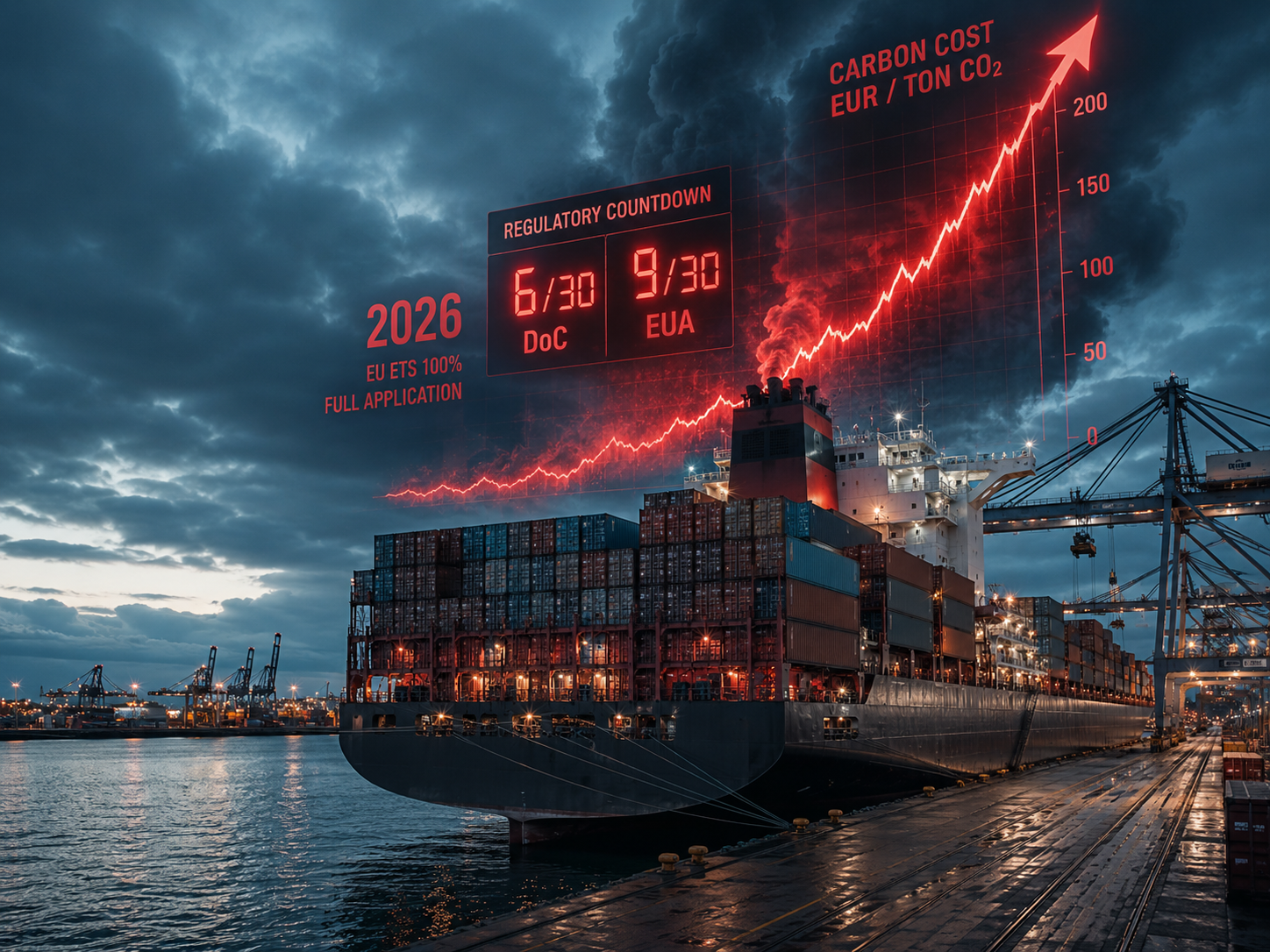
The fuel invoice jumps 45% overnight, while the 30 June Document of Compliance deadline and the 30 September allowance surrender date close in together. At that point the owner question is no longer how to avoid the rules, but how far the efficiency of the existing fleet can be pushed.
2026 is the year two European maritime environmental regimes peak at the same time. On one side, FuelEU Maritime moves into full operation. On the other, the EU Emissions Trading System (EU ETS) shifts to a 100% phase-in. Neither is a voluntary guideline. Both are binding law, enforced through port access restrictions and financial penalties.
This article frames that shift from the perspective of vessel procurement and maintenance. The core point is simple. In a transition where new tonnage cannot be delivered in time, regulatory cost is not an unavoidable fixed expense. It is a variable that can be reduced through engine efficiency and maintenance precision, and managing that variable ultimately comes down to a procurement question: can genuine parts arrive at the vessel, on time, with the correct specification?
1. Why this matters now
FuelEU Maritime entered into force on 1 January 2025. It sets an annual average greenhouse gas intensity limit for all passenger and cargo ships above 5,000 GT calling at European Economic Area (EEA) ports. The baseline is the 2020 global fleet average of roughly 91.16 gCO₂e/MJ, tightening on a five-year cycle: a 2% cut from 2025, then 6% by 2030, 14.5% by 2035, 31% by 2040, 62% by 2045, and 80% by 2050. The starting reduction looks modest, but a progressive penalty structure combined with widening scope gives it enough economic force to push non-compliant operators out of the market.
EU ETS brings an even larger change. The shipping coverage ratio rose from 40% in 2024 to 70% in 2025, and became a full 100% obligation from 1 January 2026. Owners and ship managers must secure and surrender European Union Allowances (EUAs) for all 2026 emissions by 30 September each year. The covered gases have also expanded. Beyond carbon dioxide (CO₂), methane (CH₄) and nitrous oxide (N₂O) are now included, which turns methane slip (the release of unburned methane from LNG dual-fuel engines) into a direct cost driver.
The problem is that the exit is blocked. Regulation has tightened, yet newbuild slots are severely scarce. With uncertainty over whether methanol, ammonia, or hydrogen will become the dominant future fuel, owners are deferring multi-million dollar newbuild orders. The result is structural: the rules have arrived, but new ships cannot. The answer converges on raising the efficiency of the ships already in service.
2. Translating regulatory cost into money
Non-compliance and engine inefficiency do not return as environmental scores. They return as cash outflow. Here is what the loss looks like for a purchasing manager or owner, expressed in money.
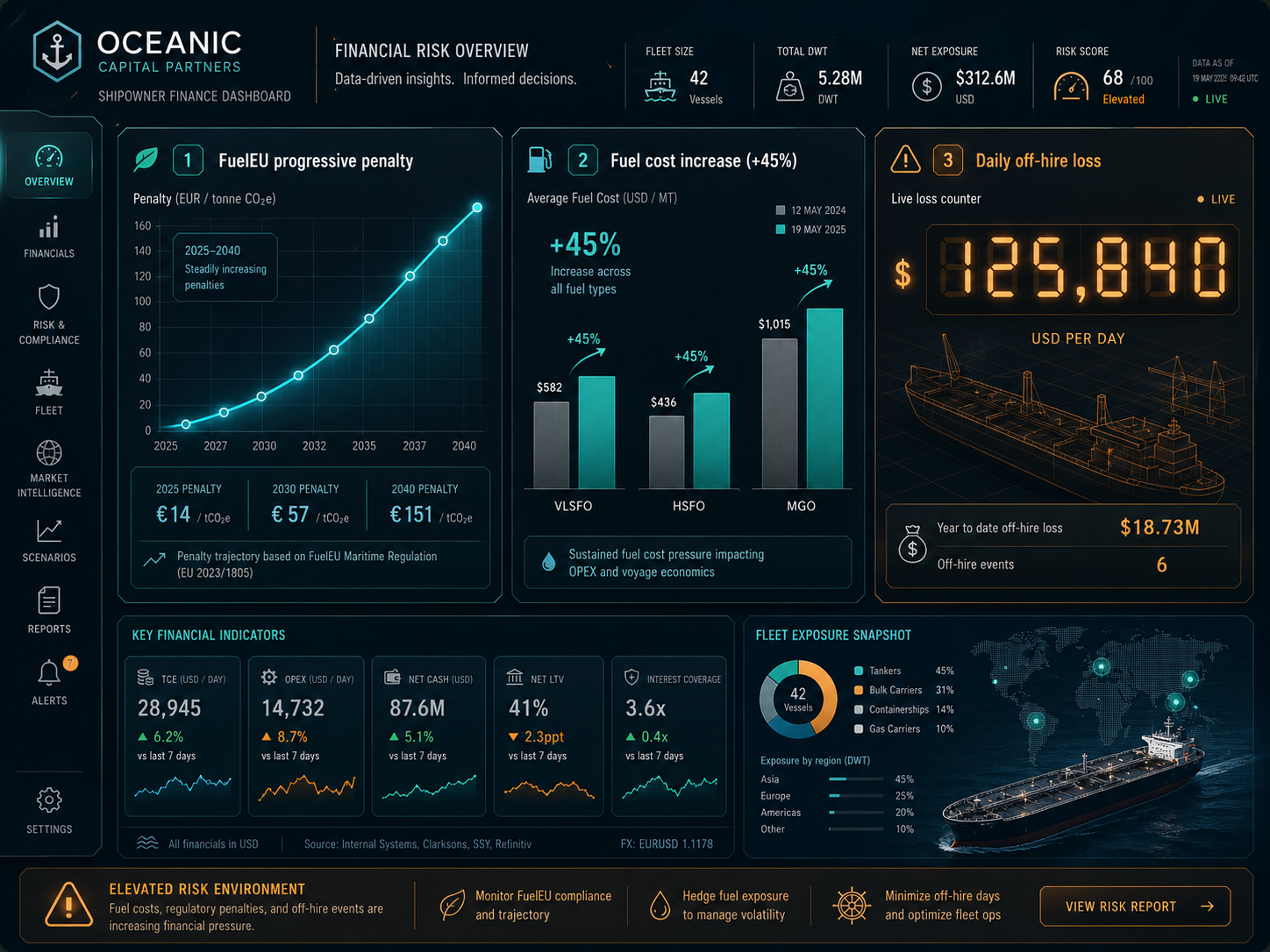
Start with the FuelEU penalty. A vessel exceeding the GHG intensity limit faces a penalty of EUR 2,400 per tonne of VLSFO energy equivalent (about 41,000 MJ), or roughly EUR 58.54 per GJ. It also compounds: consecutive non-compliance adds a 10% surcharge per occurrence, so one year shortfall grows into a larger invoice the next. One specialist analysis of about 13,000 vessels calling at EU/EEA ports estimated that, without efficiency improvement, the industry could face up to roughly EUR 1.345 billion in annual penalties and a cumulative EUR 81 billion by 2050.
The EU ETS 100% phase-in lands directly on fuel cost. In an analysis assuming an early-2026 EUA price of about EUR 85, the effective carbon-loaded cost of the main fuel grades jumped by roughly 45%.
Fuel grade | 2025-12-31 (70% basis, $/mt) | 2026-01-01 (100% basis, $/mt) | Effective change |
|---|---|---|---|
VLSFO | About $220 | About $319 | About +45% |
HSFO | About $217 | About $315 | About +45% |
(LS)MGO | About $224 | About $324 | About +45% |
EUA prices are expected to keep rising at roughly 7% per year, reaching EUR 400-500 per tonne in the 2040s and potentially above EUR 1,000 under short-term supply imbalance. Vessels older than 15 years burn more fuel per tonne-mile because of degraded combustion efficiency and aging components, so this cost flows straight into a worse profit and loss statement.
And it is not only regulatory cost. When a retrofit or efficiency upgrade meets a mismatch between design drawings and the actual hull, rework appears in the dock (cutting and re-welding piping) and off-hire stretches longer.
Cost factor | Estimated cost range | Cumulative impact |
|---|---|---|
Loss of charter hire (Off-hire) | At about $35,000/day, a 4-day delay is about $140,000 | Just four days over the dock schedule can erase charter revenue |
Excess dock daily rate | Tens of thousands of dollars per day plus added labor | Schedule breaches trigger yard change orders and higher quotes |
Fragmented survey | Repeated short off-hire accumulating | Without stacked surveys, management cost multiplies |
FuelEU penalty | Up to about EUR 1.345 billion annually (fleet total) | Two consecutive DoC failures can mean an EEA expulsion order |
In the end the cost was never the few thousand dollars of a part. It was the tens of thousands of dollars per day created by engine efficiency and maintenance precision. The issue is not price. It is efficiency and precision.
3. Engine parts optimization and 3D scanning
In a transition where newbuilds cannot be waited for, the most cost-effective and immediate emission-reduction lever has proven to be precise tuning and timely replacement of core engine components. That is why demand for vessel lifecycle optimization and bridge retrofit keeps rising.
Core engine component | Optimization approach | Fuel consumption (SFOC) effect | Emission and reliability effect |
|---|---|---|---|
Fuel injectors and nozzles | DLC coating and fine orifices, electronically controlled split injection | About 4-6% SFOC improvement with injection control, about 1-3% more with additives | Soot down up to about 68%, NOx blocked up to about 24% |
Cylinder liners | Artificial neural network (ANN) design, plateau honing and micro-texturing | About 7.5% lower friction resistance with precise texturing | Thermal stress down up to about 20%, blow-by and scuffing prevented |
F.O. high-pressure pipe | High-strength seamless steel pipe, reinforced for 1,600-2,500 bar | Higher indicated thermal efficiency (ITE) via ripple-free, uniform flow | Prevents leakage, vibration, and fatigue failure; avoids injection-timing error |
The mechanism is as follows. As the fuel injection system wears slightly, atomization deteriorates, fuel droplets grow larger, and delayed ignition leaves unburned carbon sludge accumulating on cylinders and exhaust valves. That translates directly into fuel loss and a higher carbon bill. In dual-fuel combustion, applying high-pressure injection shortens the combustion duration, raising indicated thermal efficiency by about 4.6% versus a diesel baseline and cutting greenhouse gas emissions by up to about 24% on a CO₂-equivalent basis in reported cases. For cylinder liners, plateau honing creates micro oil pockets, and combining a biomimetic surface texture sharply improves lubricant transport, permanently lowering cumulative fuel cost.
The biggest reef in any retrofit is the geometric mismatch between the as-built drawing and the real hull. Over years of repair and equipment change, compartments and piping drift from the drawing, and for some older second-hand vessels the original precise CAD is hard to obtain at all. If spool pipes are pre-fabricated in bulk and sent to the repair yard without 3D measurement, interference, gaps, and position errors appear in the dock, producing weeks of re-welding rework.
The remedy is precise measurement before docking. When an engineer scans the engine room to the millimeter with a portable 3D scanner, a point cloud of hundreds of thousands to millions of points per second is converted into a digital twin. Validating and correcting equipment interference and pipe connections in a virtual environment controls design error in advance, shortening retrofit assembly time by at least about 25% versus a drawing-dependent method and directly saving about 15% of total retrofit capital expenditure (CAPEX) by eliminating material waste and rework.
Engine efficiency and measurement precision look like technical problems, but they resolve into a procurement question: can the genuine part arrive on time, with the correct specification, at the vessel?
4. How BAS KOREA positions the solution
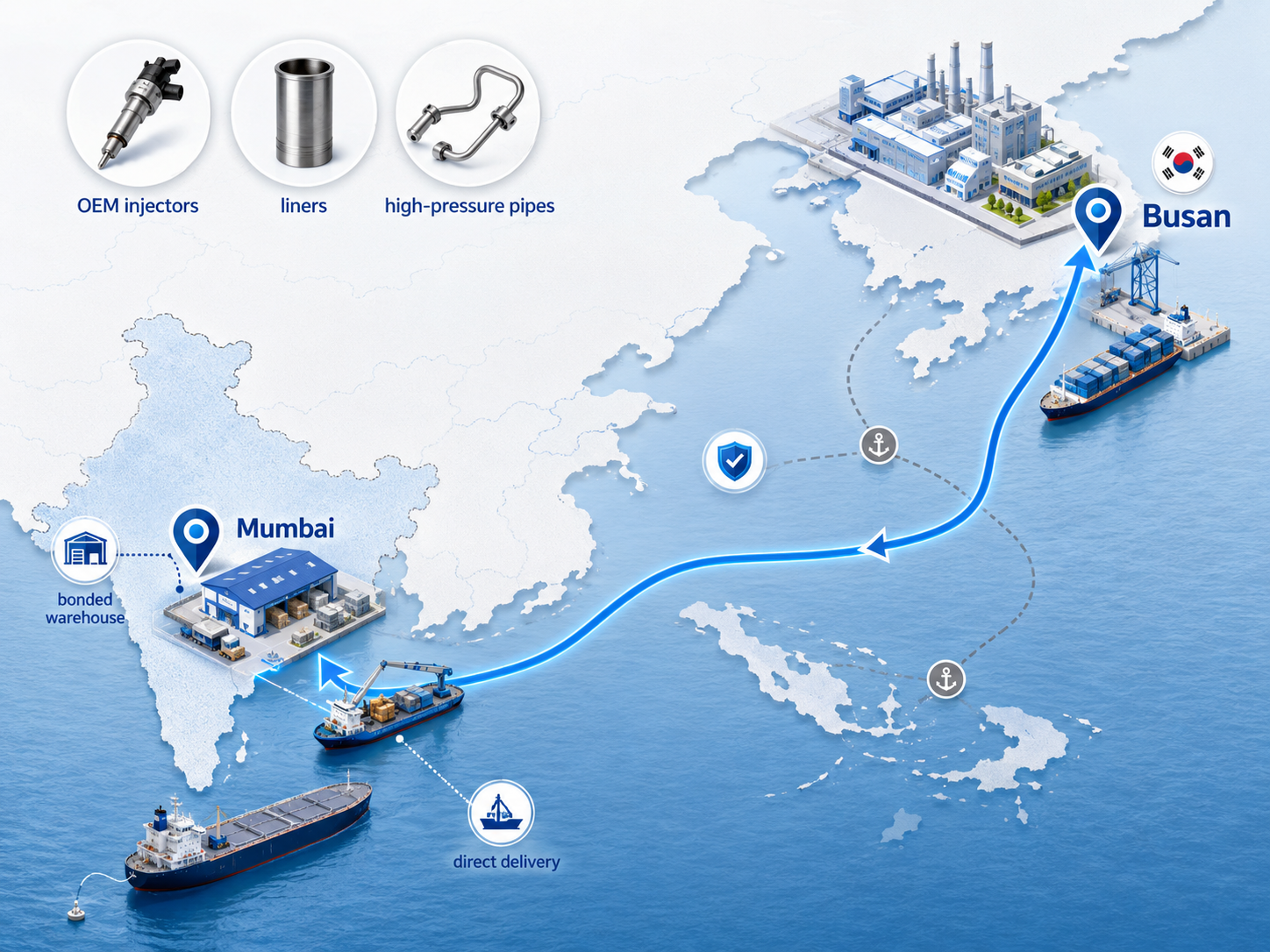
Each pain point set out above is taken up, one by one, by BAS KOREA nodes and services.
Pain point | BAS KOREA response | Key effect |
|---|---|---|
Newbuild slot scarcity | Busan OEM direct-sourcing node | Shorter lead time on genuine injectors, liners, and high-pressure pipes from major engine makers |
Deadline pressure (30 Jun DoC, 30 Sep EUA) | Bonded-warehouse safety stock | Converts urgent procurement into routine procurement |
Drawing mismatch and dock rework | Specification matching plus Busan customs and multimodal transport | Fast outbound after verifying the spec confirmed by 3D scanning |
Indian Ocean route and urgent supply | Mumbai direct office plus direct delivery | Bonded storage, then delivery to anchorage by barge |
In practice, Busan sits behind a dense southeastern Korean manufacturing belt and can directly source genuine (OEM) parts from major engine makers without separate waiting, shortening lead time for retrofit-critical components. Bonded warehouse safety stock turns deadline-driven emergency buys around dates like 30 June DoC and 30 September EUA into routine procurement. The Mumbai direct network acts as a geopolitical buffer on Indian Ocean routes, performing direct delivery to outer anchorages after bonded storage. A digital RFQ workflow that structures part details, delivery dates, and urgency reduces quotation round-trips.
Combining its Busan headquarters and Mumbai direct office, BAS KOREA connects roughly 300 shipping groups and around 800 marine equipment supply partners worldwide, and supports parts supply aligned to regulatory and maintenance schedules through its Store Management Service. Regulatory penalty is not an unavoidable fixed cost. It is a variable that genuine parts and precise maintenance can reduce.
5. What purchasing teams should check first
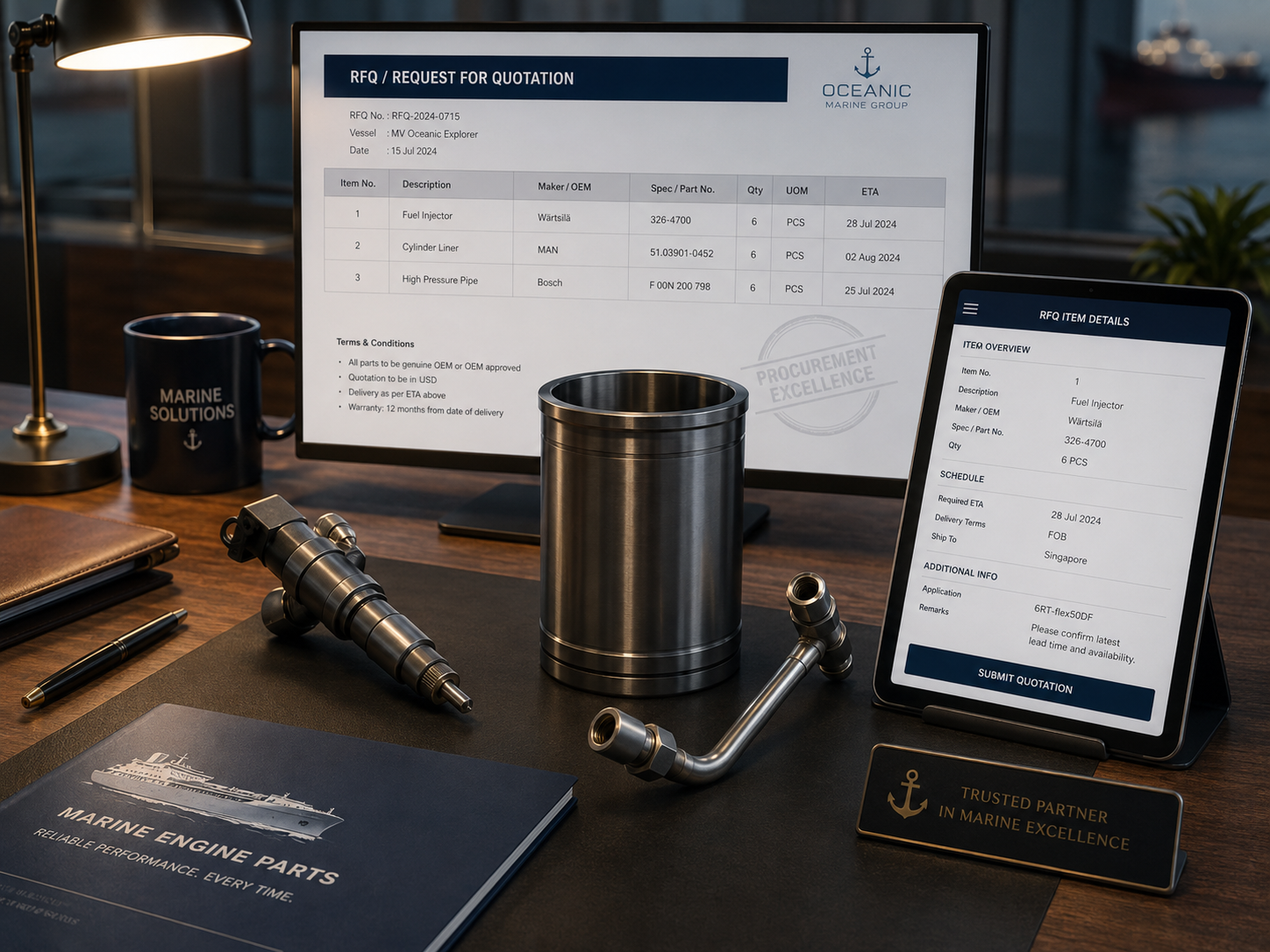
Before sending an urgent RFQ for regulation-driven parts, purchasing teams can sharply reduce quotation round-trips and procurement time by preparing four blocks of information.
Vessel and company details: company name, contact, vessel name and IMO number, vessel type.
Part requirement: maker, item description and specification, quantity, and acceptable class (genuine / OEM / compatible).
Delivery condition: target port, vessel ETA, urgency level (routine / urgent / emergency off-hire).
Special constraints: multimodal transport or bonded storage needs, and whether it ties to a regulatory deadline (DoC / EUA).
These details are not a formatting nicety for a cleaner quote. They are operating information that determines how early the right procurement route can be chosen.
6. Result and the next operating principle
The biggest shift is moving procurement from a price-only conversation to a time-risk conversation. In ordinary conditions, unit price and availability are the main comparison points. In the 2026 regulatory environment, that is not enough. Even with a lower part price, if the procurement route misses a regulatory deadline or dock window, the total loss grows through penalties and off-hire.
The more useful question is this: which sourcing, maintenance, and logistics path lowers the total risk of regulatory cost and vessel downtime? In the end, the regulatory penalty is not an unavoidable fixed cost but a variable that engine efficiency can reduce, and engine parts strategy should be designed around vessel continuity rather than unit price.
7. Closing
The 2026 EU ETS 100% phase-in and FuelEU penalties are a real financial pressure for operators running aging fleets. But that pressure is a variable that engine parts optimization and precise retrofit can reduce, and the starting point for managing it is procurement that secures genuine parts on time, with the correct specification.
For technical inquiries or RFQ discussion, BAS KOREA can review maker information, part specifications, target port, ETA, and urgency level to propose a practical Busan-Mumbai based procurement route.
Official inquiry: info@bas-korea.com
Emergency call: +82-51-977-7070